


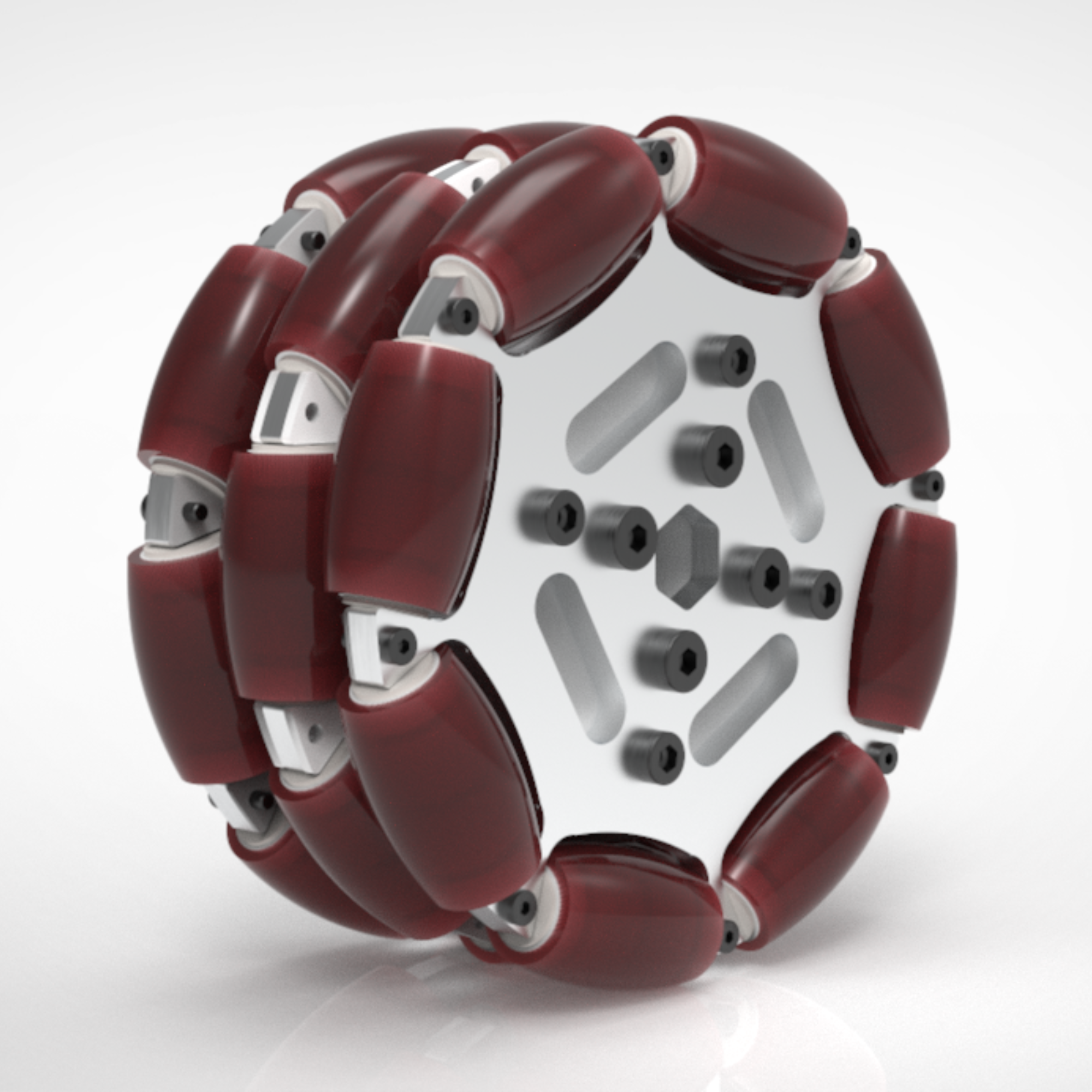
Project Overview
The Mechatronic Research Lab (MRL) required an advanced omni-directional wheel system to serve as the core traction and mobility platform for an autonomous mobile robot. Autonomous multi-directional platforms must manoeuvre instantaneously across arbitrary planar vectors without pivoting the drive axle, necessitating specialised peripheral rollers positioned around the circumference of the main wheel hub.
Cadrill undertook the complete mechanical engineering design of the wheel assembly, determining roller curvature profiles, selecting durable polyurethane contact materials, integrating precision flanged miniature bearings and preparing CNC milling drawings for the aluminium hub plates.
The Engineering Challenge
Omni-directional wheels experience severe combined dynamic forces: radial drive loads across the main hub and continuous transverse shearing forces as the peripheral rollers slide laterally across the floor surface. Standard rubber rollers frequently suffer from rapid scuffing, de-bonding or erratic friction, while unguided roller pins can bind under moment loads.
The peripheral envelope of the individual barrel-shaped rollers had to form a true circular composite circumference when viewed in side elevation, preventing vertical vibration and bumpy rolling transitions during high-speed directional changes.
Cadrill's Design Approach
Cadrill approached the mechanical design with a focus on geometric precision, material performance and machining feasibility:
Roller Envelope Geometry: Using advanced 3D CAD modelling, each roller’s hyperbolic surface profile was mathematically calculated and verified to ensure that the composite rolling envelope formed a uniform circle across all angles of rotation.
Polyurethane Material & Bearing Integration: Polyurethane rollers were engineered to provide high traction without premature wear. Miniature flanged ball bearings were recessed into both ends of each roller, with the flange retaining the bearing axially against side-thrust loads generated during lateral sliding.
CNC Milled Hub Plates: The central carrier plates were designed for multi-axis CNC milling, incorporating precision-drilled pin retaining bores, lightening pockets to minimise rotational inertia, and robust central drive shaft keyways.
Manufacture-Ready Design
To allow precision toolmakers and CNC machine shops to fabricate the assembly accurately, Cadrill issued complete manufacturing documentation:
- 2D production drawings for the CNC-milled aluminium wheel hubs with geometric dimensioning and tolerancing (GD&T) on bearing pockets and pin centres.
- Detailed drawings for roller mould tooling to cast the polyurethane contact rings with consistent shore hardness.
- Shaft and pin drawings specifying ground surface finishes and retention circlip grooves.
- Full assembly drawings documenting bearing pre-load shims, fastener torques and exploded-view BOM.
Project Outcome
The completed omni-directional wheel design gave the research team a reliable, low-friction mobility platform capable of agile multi-directional navigation. The integration of durable polyurethane rollers and flanged bearings eliminated premature roller failure and delivered fluid robotic motion during intensive laboratory trials and competitive testing.
Related Mechanical Design Services in Liverpool
If your business or engineering team requires robotic mechanism design, precision CNC machining, mobile automation hardware or CAD drawings in Liverpool, Cadrill provides specialist engineering support. From bespoke wheel hubs and transmission linkages to autonomous system packaging and dynamic CAD assemblies, we work with robotics innovators, university research groups and automation manufacturers throughout Liverpool, Merseyside and the UK.